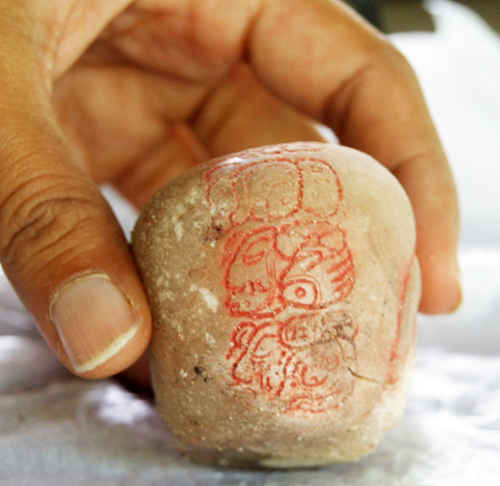
Maya Chama Cup, Guatemala, from The Maya Vase Conservation Project (Lynn A. Grant, 2006).
PHILADELPHIA, PA.-
As a repository of wide-ranging, international collections, original
field notes and archival data from roughly 300 archaeological and
anthropological expeditions around the world, the Penn Museum
in Philadelphia is committed to open, global, digital access for
scholars and the public. In 2012, celebrating the Museum's 125th
anniversary, the Penn Museum launched two online projects to expand
access to its collections and share information about its research
history: the online Collections Database and interactive Research Map
and Timeline. While those projects continue to grow, the Museum has
partnered with Digital Antiquity to further expand research data access
to scholars.
Increased Data, Accessibility on www.penn.museum
Launched in January 2012, the online Collections Database has
gradually expanded over the past 18 months with a wealth of additional
content. It now contains more than 332,851 object records representing
692,850 objects, and more than 90,000 images illustrating 34,067 object
records. In addition to the growth in available data, the functionality
of the online interface has also been improved, allowing more refined
searching and browsing of the Museum’s collections, and—new this
month—the ability for online visitors to download the Museum’s
collections metadata to sort, study, and use it to suit their own
research interests under a CC BY 3.0 Creative Commons license.
Launched in December 2012, the interactive Research Map and Timeline
highlights many of the Museum's research projects since its founding in
1887. Initially, showcasing 125 projects (commemorating the Museum’s
125th anniversary on December 6, 2012), the interactive website has now
grown to include 267 research projects.
New Partnership with Digital Antiquity Expands Scholarly Access
Finally, in another recent expansion of scholarly access, the Penn
Museum has partnered with Digital Antiquity—a collaborative non-profit
organization devoted to enhancing preservation of and access to
irreplaceable archaeological records and data—to provide free, open
access to supplementary material from 19 books previously published by
the Museum since 2000. This supplementary material—archaeological data
sets, color images, and original field reports from scholarly
expeditions—is now available online at tDAR—The Digital Archaeological
Record—a unique digital repository for archaeological data. Previously
provided on CDs or DVDs in the back of the Museum’s research
publications, these supplementary materials are now available for
download free of charge by registered tDAR users. Since tDAR’s content
is indexed by major search engines, this collaboration exposes the
Museum’s published digital content to searchers who may otherwise be
unaware of these books and their associated digital media. The books
themselves are available for purchase at the University of Pennsylvania
Press (Penn Press) website. Supplementary materials are currently
available for the following books:
Asia & the Pacific
•Ban Chiang, a Prehistoric Village Site in Northeast Thailand, Volume 1: The Human Skeletal Remain
•Mapping Mongolia: Situating Mongolia in the World from Geologic Time to the Present
•Santa Cruz Island Figure Sculpture and Its Social and Ritual Contexts
Middle East/Eurasia
•Botanical Aspects of Environment and Economy at Gordion, Turkey
•Exploring Iran: The Photography of Erich F. Schmidt, 1930-1940
•Gordion Seals and Sealings Individuals and Society
•Prehistoric Hunter-Gatherers of the Baikal Region, Siberia Bioarchaeological Studies of Past Life Ways
•Peoples and Crafts in Period IVB at Hasanlu, Iran
Mesoamerica
•Tikal Report 11: Map of the Ruins of Tikal, El Petén, Guatemala and Georeferenced Versions of the Maps Therein
•The Artifacts of Tikal—Ornamental and Ceremonial Artifacts and Unworked Material Tikal, Report 27A
•The Artifacts of Tikal—Utilitarian Artifacts and Unworked Material Tikal Report 27B
•The Maya Vase Conservation Project
•Settlement Archaeology at Quiriguá, Guatemala
•Tikal Report 34, Part A: Additions and Alterations: A Commentary on the Architecture of the North Acropolis, Tikal, Guatemala
•Tikal Report 37: Historical Archaeology at Tikal, Guatemala
Europe
•Dún Ailinne: Excavations at an Irish Royal Site, 1968-1975
•Etruscan Myth, Sacred History, and Legend
•Reports on the Vrokastro Area, Eastern Crete, Volume 2: The Settlement History of the Vrokastro Area and Related Studies
•Reports on the Vrokastro Area, Eastern Crete, Volume 3 The Vrokastro Regional Survey Project, Sites and Pottery
Source: artdaily.org
PHILADELPHIA, PA.- As a
repository of wide-ranging, international collections, original field
notes and archival data from roughly 300 archaeological and
anthropological expeditions around the world, the Penn Museum in
Philadelphia is committed to open, global, digital access for scholars
and the public. In 2012, celebrating the Museum's 125th anniversary, the
Penn Museum launched two online projects to expand access to its
collections and share information about its research history: the online
Collections Database and interactive Research Map and Timeline. While
those projects continue to grow, the Museum has partnered with Digital
Antiquity to further expand research data access to scholars.
Increased Data, Accessibility on www.penn.museum
Launched in January 2012, the online Collections Database has gradually
expanded over the past 18 months with a wealth of additional content. It
now contains more than 332,851 object records representing 692,850
objects, and more than 90,000 images illustrating 34,067 object records.
In addition to the growth in available data, the functionality of the
online interface has also been improved, allowing more refined searching
and browsing of the Museum’s collections, and—new this month—the
ability for online visitors to download the Museum’s collections
metadata to sort, study, and use it to suit their own research interests
under a CC BY 3.0 Creative Commons license.
Launched in December 2012, the interactive Research Map and Timeline
highlights many of the Museum's research projects since its founding in
1887. Initially, showcasing 125 projects (commemorating the Museum’s
125th anniversary on December 6, 2012), the interactive website has now
grown to include 267 research projects.
New Partnership with Digital Antiquity Expands Scholarly Access
Finally, in another recent expansion of scholarly access, the Penn
Museum has partnered with Digital Antiquity—a collaborative non-profit
organization devoted to enhancing preservation of and access to
irreplaceable archaeological records and data—to provide free, open
access to supplementary material from 19 books previously published by
the Museum since 2000. This supplementary material—archaeological data
sets, color images, and original field reports from scholarly
expeditions—is now available online at tDAR—The Digital Archaeological
Record—a unique digital repository for archaeological data. Previously
provided on CDs or DVDs in the back of the Museum’s research
publications, these supplementary materials are now available for
download free of charge by registered tDAR users. Since tDAR’s content
is indexed by major search engines, this collaboration exposes the
Museum’s published digital content to searchers who may otherwise be
unaware of these books and their associated digital media. The books
themselves are available for purchase at the University of Pennsylvania
Press (Penn Press) website. Supplementary materials are currently
available for the following books:
Asia & the Pacific
•Ban Chiang, a Prehistoric Village Site in Northeast Thailand, Volume 1:
The Human Skeletal Remains
•Mapping Mongolia: Situating Mongolia in the World from Geologic Time to
the Present
•Santa Cruz Island Figure Sculpture and Its Social and Ritual Contexts
Middle East/Eurasia
•Botanical Aspects of Environment and Economy at Gordion, Turkey
•Exploring Iran: The Photography of Erich F. Schmidt, 1930-1940
•Gordion Seals and Sealings Individuals and Society
•Prehistoric Hunter-Gatherers of the Baikal Region, Siberia
Bioarchaeological Studies of Past Life Ways
•Peoples and Crafts in Period IVB at Hasanlu, Iran
Mesoamerica
•Tikal Report 11: Map of the Ruins of Tikal, El Petén, Guatemala and
Georeferenced Versions of the Maps Therein
•The Artifacts of Tikal—Ornamental and Ceremonial Artifacts and Unworked
Material Tikal, Report 27A
•The Artifacts of Tikal—Utilitarian Artifacts and Unworked Material
Tikal Report 27B
•The Maya Vase Conservation Project
•Settlement Archaeology at Quiriguá, Guatemala
•Tikal Report 34, Part A: Additions and Alterations: A Commentary on the
Architecture of the North Acropolis, Tikal, Guatemala
•Tikal Report 37: Historical Archaeology at Tikal, Guatemala
Europe
•Dún Ailinne: Excavations at an Irish Royal Site, 1968-1975
•Etruscan Myth, Sacred History, and Legend
•Reports on the Vrokastro Area, Eastern Crete, Volume 2: The Settlement
History of the Vrokastro Area and Related Studies
•Reports on the Vrokastro Area, Eastern Crete, Volume 3 The Vrokastro
Regional Survey Project, Sites and Pottery
More Information:
http://artdaily.com/news/63985/The-Penn-Museum-expands-digital-access-to-its-collections-and-research-projects#.UfNY221vaSo[/url]
Copyright © artdaily.org
PHILADELPHIA, PA.- As a
repository of wide-ranging, international collections, original field
notes and archival data from roughly 300 archaeological and
anthropological expeditions around the world, the Penn Museum in
Philadelphia is committed to open, global, digital access for scholars
and the public. In 2012, celebrating the Museum's 125th anniversary, the
Penn Museum launched two online projects to expand access to its
collections and share information about its research history: the online
Collections Database and interactive Research Map and Timeline. While
those projects continue to grow, the Museum has partnered with Digital
Antiquity to further expand research data access to scholars.
Increased Data, Accessibility on www.penn.museum
Launched in January 2012, the online Collections Database has gradually
expanded over the past 18 months with a wealth of additional content. It
now contains more than 332,851 object records representing 692,850
objects, and more than 90,000 images illustrating 34,067 object records.
In addition to the growth in available data, the functionality of the
online interface has also been improved, allowing more refined searching
and browsing of the Museum’s collections, and—new this month—the
ability for online visitors to download the Museum’s collections
metadata to sort, study, and use it to suit their own research interests
under a CC BY 3.0 Creative Commons license.
Launched in December 2012, the interactive Research Map and Timeline
highlights many of the Museum's research projects since its founding in
1887. Initially, showcasing 125 projects (commemorating the Museum’s
125th anniversary on December 6, 2012), the interactive website has now
grown to include 267 research projects.
New Partnership with Digital Antiquity Expands Scholarly Access
Finally, in another recent expansion of scholarly access, the Penn
Museum has partnered with Digital Antiquity—a collaborative non-profit
organization devoted to enhancing preservation of and access to
irreplaceable archaeological records and data—to provide free, open
access to supplementary material from 19 books previously published by
the Museum since 2000. This supplementary material—archaeological data
sets, color images, and original field reports from scholarly
expeditions—is now available online at tDAR—The Digital Archaeological
Record—a unique digital repository for archaeological data. Previously
provided on CDs or DVDs in the back of the Museum’s research
publications, these supplementary materials are now available for
download free of charge by registered tDAR users. Since tDAR’s content
is indexed by major search engines, this collaboration exposes the
Museum’s published digital content to searchers who may otherwise be
unaware of these books and their associated digital media. The books
themselves are available for purchase at the University of Pennsylvania
Press (Penn Press) website. Supplementary materials are currently
available for the following books:
Asia & the Pacific
•Ban Chiang, a Prehistoric Village Site in Northeast Thailand, Volume 1:
The Human Skeletal Remains
•Mapping Mongolia: Situating Mongolia in the World from Geologic Time to
the Present
•Santa Cruz Island Figure Sculpture and Its Social and Ritual Contexts
Middle East/Eurasia
•Botanical Aspects of Environment and Economy at Gordion, Turkey
•Exploring Iran: The Photography of Erich F. Schmidt, 1930-1940
•Gordion Seals and Sealings Individuals and Society
•Prehistoric Hunter-Gatherers of the Baikal Region, Siberia
Bioarchaeological Studies of Past Life Ways
•Peoples and Crafts in Period IVB at Hasanlu, Iran
Mesoamerica
•Tikal Report 11: Map of the Ruins of Tikal, El Petén, Guatemala and
Georeferenced Versions of the Maps Therein
•The Artifacts of Tikal—Ornamental and Ceremonial Artifacts and Unworked
Material Tikal, Report 27A
•The Artifacts of Tikal—Utilitarian Artifacts and Unworked Material
Tikal Report 27B
•The Maya Vase Conservation Project
•Settlement Archaeology at Quiriguá, Guatemala
•Tikal Report 34, Part A: Additions and Alterations: A Commentary on the
Architecture of the North Acropolis, Tikal, Guatemala
•Tikal Report 37: Historical Archaeology at Tikal, Guatemala
Europe
•Dún Ailinne: Excavations at an Irish Royal Site, 1968-1975
•Etruscan Myth, Sacred History, and Legend
•Reports on the Vrokastro Area, Eastern Crete, Volume 2: The Settlement
History of the Vrokastro Area and Related Studies
•Reports on the Vrokastro Area, Eastern Crete, Volume 3 The Vrokastro
Regional Survey Project, Sites and Pottery
More Information:
http://artdaily.com/news/63985/The-Penn-Museum-expands-digital-access-to-its-collections-and-research-projects#.UfNY221vaSo[/url]
Copyright © artdaily.org
PHILADELPHIA, PA.- As a
repository of wide-ranging, international collections, original field
notes and archival data from roughly 300 archaeological and
anthropological expeditions around the world, the Penn Museum in
Philadelphia is committed to open, global, digital access for scholars
and the public. In 2012, celebrating the Museum's 125th anniversary, the
Penn Museum launched two online projects to expand access to its
collections and share information about its research history: the online
Collections Database and interactive Research Map and Timeline. While
those projects continue to grow, the Museum has partnered with Digital
Antiquity to further expand research data access to scholars.
Increased Data, Accessibility on www.penn.museum
Launched in January 2012, the online Collections Database has gradually
expanded over the past 18 months with a wealth of additional content. It
now contains more than 332,851 object records representing 692,850
objects, and more than 90,000 images illustrating 34,067 object records.
In addition to the growth in available data, the functionality of the
online interface has also been improved, allowing more refined searching
and browsing of the Museum’s collections, and—new this month—the
ability for online visitors to download the Museum’s collections
metadata to sort, study, and use it to suit their own research interests
under a CC BY 3.0 Creative Commons license.
Launched in December 2012, the interactive Research Map and Timeline
highlights many of the Museum's research projects since its founding in
1887. Initially, showcasing 125 projects (commemorating the Museum’s
125th anniversary on December 6, 2012), the interactive website has now
grown to include 267 research projects.
New Partnership with Digital Antiquity Expands Scholarly Access
Finally, in another recent expansion of scholarly access, the Penn
Museum has partnered with Digital Antiquity—a collaborative non-profit
organization devoted to enhancing preservation of and access to
irreplaceable archaeological records and data—to provide free, open
access to supplementary material from 19 books previously published by
the Museum since 2000. This supplementary material—archaeological data
sets, color images, and original field reports from scholarly
expeditions—is now available online at tDAR—The Digital Archaeological
Record—a unique digital repository for archaeological data. Previously
provided on CDs or DVDs in the back of the Museum’s research
publications, these supplementary materials are now available for
download free of charge by registered tDAR users. Since tDAR’s content
is indexed by major search engines, this collaboration exposes the
Museum’s published digital content to searchers who may otherwise be
unaware of these books and their associated digital media. The books
themselves are available for purchase at the University of Pennsylvania
Press (Penn Press) website. Supplementary materials are currently
available for the following books:
Asia & the Pacific
•Ban Chiang, a Prehistoric Village Site in Northeast Thailand, Volume 1:
The Human Skeletal Remains
•Mapping Mongolia: Situating Mongolia in the World from Geologic Time to
the Present
•Santa Cruz Island Figure Sculpture and Its Social and Ritual Contexts
Middle East/Eurasia
•Botanical Aspects of Environment and Economy at Gordion, Turkey
•Exploring Iran: The Photography of Erich F. Schmidt, 1930-1940
•Gordion Seals and Sealings Individuals and Society
•Prehistoric Hunter-Gatherers of the Baikal Region, Siberia
Bioarchaeological Studies of Past Life Ways
•Peoples and Crafts in Period IVB at Hasanlu, Iran
Mesoamerica
•Tikal Report 11: Map of the Ruins of Tikal, El Petén, Guatemala and
Georeferenced Versions of the Maps Therein
•The Artifacts of Tikal—Ornamental and Ceremonial Artifacts and Unworked
Material Tikal, Report 27A
•The Artifacts of Tikal—Utilitarian Artifacts and Unworked Material
Tikal Report 27B
•The Maya Vase Conservation Project
•Settlement Archaeology at Quiriguá, Guatemala
•Tikal Report 34, Part A: Additions and Alterations: A Commentary on the
Architecture of the North Acropolis, Tikal, Guatemala
•Tikal Report 37: Historical Archaeology at Tikal, Guatemala
Europe
•Dún Ailinne: Excavations at an Irish Royal Site, 1968-1975
•Etruscan Myth, Sacred History, and Legend
•Reports on the Vrokastro Area, Eastern Crete, Volume 2: The Settlement
History of the Vrokastro Area and Related Studies
•Reports on the Vrokastro Area, Eastern Crete, Volume 3 The Vrokastro
Regional Survey Project, Sites and Pottery
More Information:
http://artdaily.com/news/63985/The-Penn-Museum-expands-digital-access-to-its-collections-and-research-projects#.UfNY221vaSo[/url]
Copyright © artdaily.org
Maya Chama Cup,
Guatemala, from The Maya Vase Conservation Project (Lynn A. Grant,
2006).
PHILADELPHIA, PA.- As a repository of wide-ranging, international
collections, original field notes and archival data from roughly 300
archaeological and anthropological expeditions around the world, the
Penn Museum in Philadelphia is committed to open, global, digital access
for scholars and the public. In 2012, celebrating the Museum's 125th
anniversary, the Penn Museum launched two online projects to expand
access to its collections and share information about its research
history: the online Collections Database and interactive Research Map
and Timeline. While those projects continue to grow, the Museum has
partnered with Digital Antiquity to further expand research data access
to scholars.
Increased Data, Accessibility on www.penn.museum
Launched in January 2012, the online Collections Database has gradually
expanded over the past 18 months with a wealth of additional content. It
now contains more than 332,851 object records representing 692,850
objects, and more than 90,000 images illustrating 34,067 object records.
In addition to the growth in available data, the functionality of the
online interface has also been improved, allowing more refined searching
and browsing of the Museum’s collections, and—new this month—the
ability for online visitors to download the Museum’s collections
metadata to sort, study, and use it to suit their own research interests
under a CC BY 3.0 Creative Commons license.
Launched in December 2012, the interactive Research Map and Timeline
highlights many of the Museum's research projects since its founding in
1887. Initially, showcasing 125 projects (commemorating the Museum’s
125th anniversary on December 6, 2012), the interactive website has now
grown to include 267 research projects.
New Partnership with Digital Antiquity Expands Scholarly Access
Finally, in another recent expansion of scholarly access, the Penn
Museum has partnered with Digital Antiquity—a collaborative non-profit
organization devoted to enhancing preservation of and access to
irreplaceable archaeological records and data—to provide free, open
access to supplementary material from 19 books previously published by
the Museum since 2000. This supplementary material—archaeological data
sets, color images, and original field reports from scholarly
expeditions—is now available online at tDAR—The Digital Archaeological
Record—a unique digital repository for archaeological data. Previously
provided on CDs or DVDs in the back of the Museum’s research
publications, these supplementary materials are now available for
download free of charge by registered tDAR users. Since tDAR’s content
is indexed by major search engines, this collaboration exposes the
Museum’s published digital content to searchers who may otherwise be
unaware of these books and their associated digital media. The books
themselves are available for purchase at the University of Pennsylvania
Press (Penn Press) website. Supplementary materials are currently
available for the following books:
Asia & the Pacific
•Ban Chiang, a Prehistoric Village Site in Northeast Thailand, Volume 1:
The Human Skeletal Remains
•Mapping Mongolia: Situating Mongolia in the World from Geologic Time to
the Present
•Santa Cruz Island Figure Sculpture and Its Social and Ritual Contexts
Middle East/Eurasia
•Botanical Aspects of Environment and Economy at Gordion, Turkey
•Exploring Iran: The Photography of Erich F. Schmidt, 1930-1940
•Gordion Seals and Sealings Individuals and Society
•Prehistoric Hunter-Gatherers of the Baikal Region, Siberia
Bioarchaeological Studies of Past Life Ways
•Peoples and Crafts in Period IVB at Hasanlu, Iran
Mesoamerica
•Tikal Report 11: Map of the Ruins of Tikal, El Petén, Guatemala and
Georeferenced Versions of the Maps Therein
•The Artifacts of Tikal—Ornamental and Ceremonial Artifacts and Unworked
Material Tikal, Report 27A
•The Artifacts of Tikal—Utilitarian Artifacts and Unworked Material
Tikal Report 27B
•The Maya Vase Conservation Project
•Settlement Archaeology at Quiriguá, Guatemala
•Tikal Report 34, Part A: Additions and Alterations: A Commentary on the
Architecture of the North Acropolis, Tikal, Guatemala
•Tikal Report 37: Historical Archaeology at Tikal, Guatemala
Europe
•Dún Ailinne: Excavations at an Irish Royal Site, 1968-1975
•Etruscan Myth, Sacred History, and Legend
•Reports on the Vrokastro Area, Eastern Crete, Volume 2: The Settlement
History of the Vrokastro Area and Related Studies
•Reports on the Vrokastro Area, Eastern Crete, Volume 3 The Vrokastro
Regional Survey Project, Sites and Pottery
More Information:
http://artdaily.com/news/63985/The-Penn-Museum-expands-digital-access-to-its-collections-and-research-projects#.UfNY221vaSo[/url]
Copyright © artdaily.org
Maya Chama Cup,
Guatemala, from The Maya Vase Conservation Project (Lynn A. Grant,
2006).
PHILADELPHIA, PA.- As a repository of wide-ranging, international
collections, original field notes and archival data from roughly 300
archaeological and anthropological expeditions around the world, the
Penn Museum in Philadelphia is committed to open, global, digital access
for scholars and the public. In 2012, celebrating the Museum's 125th
anniversary, the Penn Museum launched two online projects to expand
access to its collections and share information about its research
history: the online Collections Database and interactive Research Map
and Timeline. While those projects continue to grow, the Museum has
partnered with Digital Antiquity to further expand research data access
to scholars.
Increased Data, Accessibility on www.penn.museum
Launched in January 2012, the online Collections Database has gradually
expanded over the past 18 months with a wealth of additional content. It
now contains more than 332,851 object records representing 692,850
objects, and more than 90,000 images illustrating 34,067 object records.
In addition to the growth in available data, the functionality of the
online interface has also been improved, allowing more refined searching
and browsing of the Museum’s collections, and—new this month—the
ability for online visitors to download the Museum’s collections
metadata to sort, study, and use it to suit their own research interests
under a CC BY 3.0 Creative Commons license.
Launched in December 2012, the interactive Research Map and Timeline
highlights many of the Museum's research projects since its founding in
1887. Initially, showcasing 125 projects (commemorating the Museum’s
125th anniversary on December 6, 2012), the interactive website has now
grown to include 267 research projects.
New Partnership with Digital Antiquity Expands Scholarly Access
Finally, in another recent expansion of scholarly access, the Penn
Museum has partnered with Digital Antiquity—a collaborative non-profit
organization devoted to enhancing preservation of and access to
irreplaceable archaeological records and data—to provide free, open
access to supplementary material from 19 books previously published by
the Museum since 2000. This supplementary material—archaeological data
sets, color images, and original field reports from scholarly
expeditions—is now available online at tDAR—The Digital Archaeological
Record—a unique digital repository for archaeological data. Previously
provided on CDs or DVDs in the back of the Museum’s research
publications, these supplementary materials are now available for
download free of charge by registered tDAR users. Since tDAR’s content
is indexed by major search engines, this collaboration exposes the
Museum’s published digital content to searchers who may otherwise be
unaware of these books and their associated digital media. The books
themselves are available for purchase at the University of Pennsylvania
Press (Penn Press) website. Supplementary materials are currently
available for the following books:
Asia & the Pacific
•Ban Chiang, a Prehistoric Village Site in Northeast Thailand, Volume 1:
The Human Skeletal Remains
•Mapping Mongolia: Situating Mongolia in the World from Geologic Time to
the Present
•Santa Cruz Island Figure Sculpture and Its Social and Ritual Contexts
Middle East/Eurasia
•Botanical Aspects of Environment and Economy at Gordion, Turkey
•Exploring Iran: The Photography of Erich F. Schmidt, 1930-1940
•Gordion Seals and Sealings Individuals and Society
•Prehistoric Hunter-Gatherers of the Baikal Region, Siberia
Bioarchaeological Studies of Past Life Ways
•Peoples and Crafts in Period IVB at Hasanlu, Iran
Mesoamerica
•Tikal Report 11: Map of the Ruins of Tikal, El Petén, Guatemala and
Georeferenced Versions of the Maps Therein
•The Artifacts of Tikal—Ornamental and Ceremonial Artifacts and Unworked
Material Tikal, Report 27A
•The Artifacts of Tikal—Utilitarian Artifacts and Unworked Material
Tikal Report 27B
•The Maya Vase Conservation Project
•Settlement Archaeology at Quiriguá, Guatemala
•Tikal Report 34, Part A: Additions and Alterations: A Commentary on the
Architecture of the North Acropolis, Tikal, Guatemala
•Tikal Report 37: Historical Archaeology at Tikal, Guatemala
Europe
•Dún Ailinne: Excavations at an Irish Royal Site, 1968-1975
•Etruscan Myth, Sacred History, and Legend
•Reports on the Vrokastro Area, Eastern Crete, Volume 2: The Settlement
History of the Vrokastro Area and Related Studies
•Reports on the Vrokastro Area, Eastern Crete, Volume 3 The Vrokastro
Regional Survey Project, Sites and Pottery
More Information:
http://artdaily.com/news/63985/The-Penn-Museum-expands-digital-access-to-its-collections-and-research-projects#.UfNY221vaSo[/url]
Copyright © artdaily.org








 Entradas