Mostrando entradas con la etiqueta Epigraphy. Mostrar todas las entradas

sábado, 14 de marzo de 2015

Archaeologist study murals adorning the walls of ancient Maya

In a complex, 1,300-year-old Maya mural in the Guatemalan jungle, a ruler with an elaborate plumed headdress and impersonating a god, consults with priest-scholars as they celebrate the new year. Though the Lord of Hammer-Stone Hill is present, it is a rare glimpse of life that is not a court scene, say the archaeologists studying it and other murals in the ancient ruins of the city of Xultun.

The archaeologists are studying not just royalty and the court, but the people of lower status too.
“Our ongoing work seeks to refine understandings of the mechanisms through which sacred royal power was legitimated and maintained, and to elucidate the roles that specialists such as the taaj [functionaries] played in those processes,” wrote the authors of an article about the murals published  in the journal Antiquity. “The Xultun mural sheds a rare light on some of these strands as they pertain to a group of seven artisans, scribes and priests; we see here, ‘set before their king’, individuals who played distinct and important roles in producing and sustaining political authority at Xultun.”

The taaj are people (one of them is depicted on the left in the photo of the mural at the top of this article) who served the ruler. Taaj means obsidian. The archaeologists are unsure why the men are called obsidian.

Sakun taaj means Senior Obsidian, and itz’in taaj means Junior Obsidian, apparent ranks of the people serving the ruler. These texts are on the walls near the figures.

Xultun was discovered in 1915 and studied in the 1920s and again in 1974 and 1975. Unfortunately, some of its artifacts, including large steles, were looted.
The website Trafficking Culture says the site has plazas, buildings and ball courts. The largest Xultun structure has a nearly square base that measures about 148 feet (45 meters) and is 79 feet (24 meters) tall. On top is a platform with a small structure.

A map shows the region, the site and the building, 10K2, where the murals are.

It seems the people of Xultun had a penchant for using minerals as proper nouns. An “epigraphic study of an emblem glyph associated with the site indicates that during the Classic Maya period Xultun was called B’aax Witz or Quartz Hill/Mountain,” Trafficking Culture says.

“Like nearly every Maya site in the Petén, Xultun was heavily looted in the 1960s and 1970s to feed the international demand for Maya ceramics and sculptural material,” the site says.
The authors of the February 2015 article in Antiquity, including lead researcher William Saturno of Boston University, started excavations at Xultun in 2008. The article gives many details on the murals and what significance they may have had to the people of the time.
The mural focuses on an order of scribal-priests, with at least four men in identical attire and at least three men who share the title taaj [obsidian], one of whom kneels in front of the ruler. The two poorly preserved seated figures on the east wall may have also held similar roles and titles. These seven men are gathered in consultation, in participation or as witnesses to the primary scene, where a royal governor celebrates a calendrical ritual that occurred during the first month of the year and which was probably related to the new year,
says the article in Antiquity.
The ruler or governor has a censer bag. The staff he is holding has lk’ symbols. The man kneeling behind is holding the ruler’s quetzal plumes.

Also depicted are two men dressed as military captains, though damage makes their identities unclear. The sharing of roles by junior and senior taaj men suggests “a religious order linked to sacrificial rites and thus obsidian blades (ubiquitous in Maya sacrificial rites), or an early guild of master craftsmen and apprentices (journeymen), who may be blood relations.” Also, they wrote, the mural suggests a guild that united trades including artists, calendrical priests and scribes.

There are many texts inscribed on the wall, dealing with astronomical, calendrical and “textual” content, they wrote.

The walls are constructed of stone blocks and wet mortar. Workers prepared the surface with a layer of mud to smooth the surface and then lime plaster.
Several scientific testing methods identified iron-oxide pigments, including hematite, Maya blue, carbon black and calcite white to make dark brown, red, orange, yellow, white, blue, blue-green and purple (red-blue) and yellow.
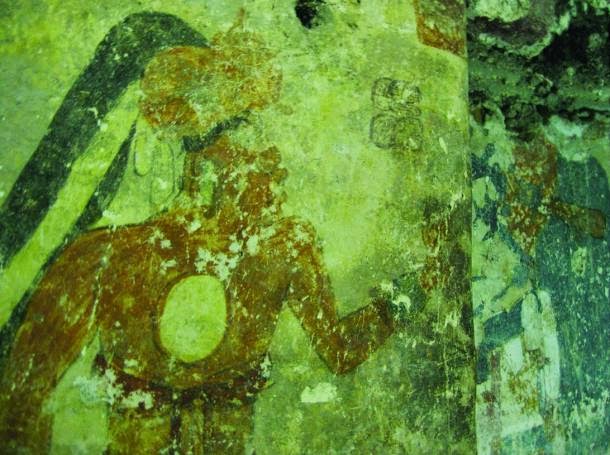
The archaeologists took scans of some of the murals because the walls are so close together they couldn’t get proper photographs. The image above is a photograph.

“On the north wall, the seated lord is distinguished by his blue-green feathers and jewelry, white shells and skeletal ornaments, as well as by calligraphic outlines in both black and red specular hematite. The materials and techniques used to paint the Xultun chamber are consistent with artworks by other master artists and scribes painting murals and pottery.”
The authors intend to write later articles detailing the results of excavations of the murals and analysis of hieroglyphic texts that are on the paintings.

Featured image: Junior Obsidian kneels before the Lord of Hammer-Stone Hill, the apparent ruler of Xultun. 


 Source: http://www.ancient-origins.net
(Illustrations from Antiquity journal)
By Mark Miller

martes, 3 de diciembre de 2013

Recuperan Panel Arqueológico Maya del Sitio Arqueológico La Corona


Este día, el Departamento de Prevención y Control de Tráfico Ilícito de Bienes Culturales, del Ministerio de Cultura y Deportes, está presentando una pieza arqueológica maya recuperada y repatriada de San Francisco, California, Estados Unidos, la cual data del Periodo Clásico (250 – 900 d. C).

La pieza arqueológica, es un panel tallado en piedra caliza, procedente de Tierras Bajas, Sitio Arqueológico La Corona, ubicado en Petén, Guatemala.  Se integra de dos columnas verticales con tres cartuchos de glifos, los cuales se encuentran en relieve.

En el año 2011, se tuvo conocimiento de la existencia de un panel arqueológico que formaba parte de la colección de un ciudadano estadounidense que se dedicaba a coleccionar bienes de las culturas prehispánicas de América, cuya recopilación formó entre la época de los años 1960 y 1970.
A la muerte del poseedor de la colección, la misma fue entregada a una casa de subastas, que pretendía comercializarla, no obstante gracias a la intervención de una persona conocedora del valor arqueológico y procedencia de la pieza como guatemalteca, sugirió la devolución de la misma a su legítimo propietario, el Estado de Guatemala.

El proceso de recuperación se coordinó entre el Ministerio de Cultura y Deportes y el Ministerio de Relaciones Exteriores para que se realizara como entrega voluntaria por parte del poseedor al Consulado de Guatemala en la Ciudad Condado de San Francisco, California, EEUU; en donde permaneció hasta poder encontrar financiamiento para repatriarla.

En los últimos 10 años, el Ministerio ha realizado recuperaciones a nivel nacional e internacional, de más de 10 mil 500 piezas, la mayoría son bienes arqueológicos, una minoría bienes religiosos y otros bienes, informó Eduardo Hernández, Jefe del Departamento de Prevención y Tráfico Ilícito de Bienes Culturales.

El MCD cumple así con su obligación constitucional y función administrativa de protección del patrimonio cultural, establecida en la Constitución Política de la República y leyes ordinarias, específicamente en lo que se refiere a la recuperación, repatriación y restitución al Estado de los bienes culturales sustraídos o exportados ilícitamente.


Esta Pieza Arqueológica maya tiene un ancho de 39cm alto y 44cm de ancho su grosor es de 7.6 cm 

La pieza estará expuesta en el Museo de Arqueología y Etnología MUNAE, ubicado en 6ª. Calle y 7ª. Av. Salón no. 5, Finca La Aurora, zona 13.  Se invita a la población guatemalteca a visitar el museo para apreciar esta pieza y toda la colección del museo,  en horario de martes a domingo de 9:00 a 17:00 Hrs.

fuente: ministerio de cultura y deportes del gobierno de Guatemala

lunes, 1 de febrero de 2010

Epigraphy Workshop with Dr. Bruce Love - Taller de Epigrafìa con el Dr. Bruce Love


Learn to Decipher Maya Glyphs with Bruce Love (traducer of the Paris Codex)

February 19th, 20th & 21 rst 2010
at the Mesoamerican Society of California State University

Aprende a descifrar Glifos con Bruce Love (traductor del Códice Paris)

Febrero 29, 20 y 21 del 2010
en la Sociedad Mesoamericana de la Universidad del Estado de California